
The New Anglo-Hellenic Review
by Jonathan Williams
As we all know, there are three sacred languages: Hebrew, Greek, and… Welsh. Medieval scholar and churchman Gerald of Wales (c.1145 – c.1223) believed firmly and truly that Welsh was a close cousin of Greek, citing in proof the similarity between the Ancient Greek and Welsh words for water: hudōr and dŵr respectively. He also spotted that Welsh word for “five”, pump, resembles its Greek equivalent, pente. Gerald’s explanation for this phenomenon, which he was the first to notice, was that his ancestors, the ancient Britons, had in the distant past spent a long time in Greece where they had picked up some of the language. Gerald was onto something. These words are indeed related to one another in the deep history of the Indo-European language family to which both Greek and Welsh belong, as was confirmed centuries later by comparative philologists. Gerald knew a bit of Welsh and some Greek. But he had enough of both to enable him to endow the obscure language of his native land with some of the prestige and antiquity of Hellenism. Little did he know that his ingenious historical explanation was back to front. It wasn’t the Ancient Britons who went to Greece, but Greeks who had come west, bringing their language and letters with them.
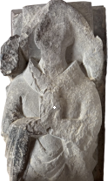
Gerald of Wales’s grave, St David’s Cathedral.
Image author Tipcake, licensed under the Creative Commons Attribution-Share Alike 4.0 International licence.
Around 600 BC, the Greek city of Massalia, modern Marseille, was founded in southern France by intrepid exiles from the far-away town of Phocaea in what is now western Turkey. Massalia remained a Greek-speaking enclave in western Europe for centuries. And about 320 BC a mariner from Massalia named Pytheas went even further than wily Odysseus, sailing out of the Mediterranean beyond the Pillars of Hercules and all the way to Britain, even reaching the region of the “frozen sea” and a far-distant island he called Thulē. Pytheas wrote a book about his voyage which, alas, did not survive the shipwreck of antiquity. But it was cited by later authors, some of whom regarded it as an unreliable farrago of traveller’s tales.
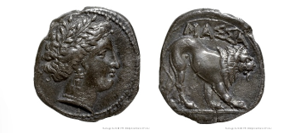
Silver drachm of Massalia, c. 200 BC. Source: Gallica.bnf.fr/Bibliothèque nationale de France
Around 200 BC, for reasons that aren’t entirely clear, the Greek alphabet and language were taken up by the so-called ‘barbarian’ peoples of iron age Celtic Europe. It’s not as if the druids of ancient Gaul (modern France) were reciting tracts of Homer, but they did use Greek letters to keep records, at least according to Julius Caesar. Caesar also records the discovery of a census record written in Greek letters in the camp of a Celtic tribe he had defeated in the course of his bloody conquest of Gaul.
By about 150 BC people in Gaul were beginning to write some Celtic words and personal names using the Greek alphabet, and even some simple texts in Greek language. All this happened just at the time when Latin language and letters also started to make inroads into north-western Europe as the Romans became the dominant power in the western Mediterranean after 200 BC.
What this meant was that both Greek and Latin alphabets were in use in ancient Gaul concurrently in the last two centuries BC. Some Gaulish coins even have the same personal name, probably that of a king, written in Greek letters on one side and Latin on the other. An otherwise unknown character from Celtic Gaul called Roveca appears on his coins as both ROVECA and ΡOOYΙΚA.
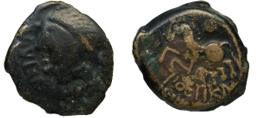
Bronze coin of Ροουικα/Roveca, c. 50 BC. You can read the Greek legend, ΡOOYΙΚA, between about 7 and 5 o’clock on the right-hand image. Source: Gallica.bnf.fr/Bibliothèque nationale de France.
Coins were themselves, of course, a technology borrowed from the Greek world which spread into Celtic Europe in the third century BC, reaching Britain perhaps around 100 BC. Perhaps around the same time as Julius Caesar’s invasion of Britain in 55 BC, the Greek alphabet crossed the Channel. Or at least one letter did. The ancient Britons were slow in taking up the habit of writing, in any form. Unlike Gaul where Greek had a headstart, the Latin alphabet got here first, and it squeezed Greek out. But there were sounds in ancient Gaulish and British that the Latin alphabet couldn’t represent, including a particular s-sound. So the Celts borrowed the Greek letter theta to write it. One ancient British king’s name was made up of the Celtic word for chariot, essedum, and the word for “big”, maros (Celtic chiefs clearly had a weakness for horse-drawn SUVs). On his coins it was written as AΘΘEDOMAROS, a splendidly eclectic mixture of Greek and Latin letters used to write ancient British sounds.
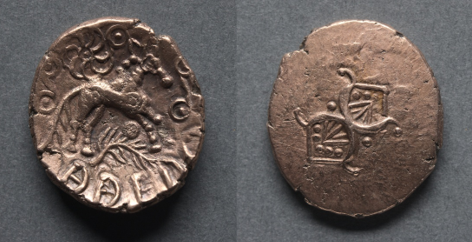
Gold coin of Aθθedomaros, c 20 BC: the two thetas are visible at about 6 and 7 o’clock in the left-hand image. Made available by the Cleveland Museum of Art under a Creative Commons Zero designation
These coin legends, adapting Latin and Greek letters to write Celtic names, are the earliest evidence for the use of writing of any sort in these islands, which is something to mark and celebrate. Greek letters, or one Greek letter at least, came to Britain along with writing itself.
Long before Anglo-Hellenism there was Britanno-Hellenism. I’m not suggesting we found a Cambro-Hellenic League. But we should perhaps not forget that the links between the Hellenic world and Britain long predate the arrival of the barbarian English, and even the supposedly civilised Romans. In later centuries Wales has produced outstanding scholars of the Greek language. Bishop William Morgan, whose translation of the Bible into Welsh, published in 1588, set the standard for the literary language for centuries to come, was learned in both Hebrew and Greek.
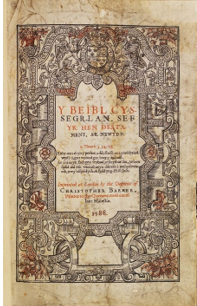
Title Page of Bishop Morgan’s translation of the Bible from Hebrew and Greek into Welsh, published 1588. Source: National Library of Wales, made available under a Creative Commons CC0 1.0 Universal Public Domain Dedication licence.
More recently, Christopher Pelling, who retired as the Oxford Regius Professor of Greek in 2015, is a Cardiff boy, and a devoted follower of Glamorgan County Cricket Club. And despite the gutting of humanities departments in universities across Britain, Swansea University still offers a Classical Studies degree with a Greek option. There is, of course, an Honorary Consulate of Greece in Cardiff.
Gerald of Wales was right after all. The Ancient Britons and their successors, the people of Wales, have a long history in common with Greece and the Greeks – they’ve been talking to one another for over 2300 years and counting.

Jonathan Williams is a Council Member of the League and a Fellow of the Learned Society of Wales. He knows about as much Welsh as Gerald, and perhaps a bit more Greek.