

The New Anglo-Hellenic Review
by Julian Hoffman, Anglo-Hellenic League Runciman Award winner 2026
Writers often say that it takes a village to raise a book, just as it does a child. But in the case of Lifelines, it took two of them. The first of these was my incredible publishing team at Elliott & Thompson, who believed in this book right from the very beginning. The other village is called Agios Germanos. It sits in a lush valley high above the Prespa lakes in northern Greece and has been my home for more than a quarter of a century now. And it is this second village – alongside its wider landscape of mountains and forests and lakes – that is at the heart of the book.
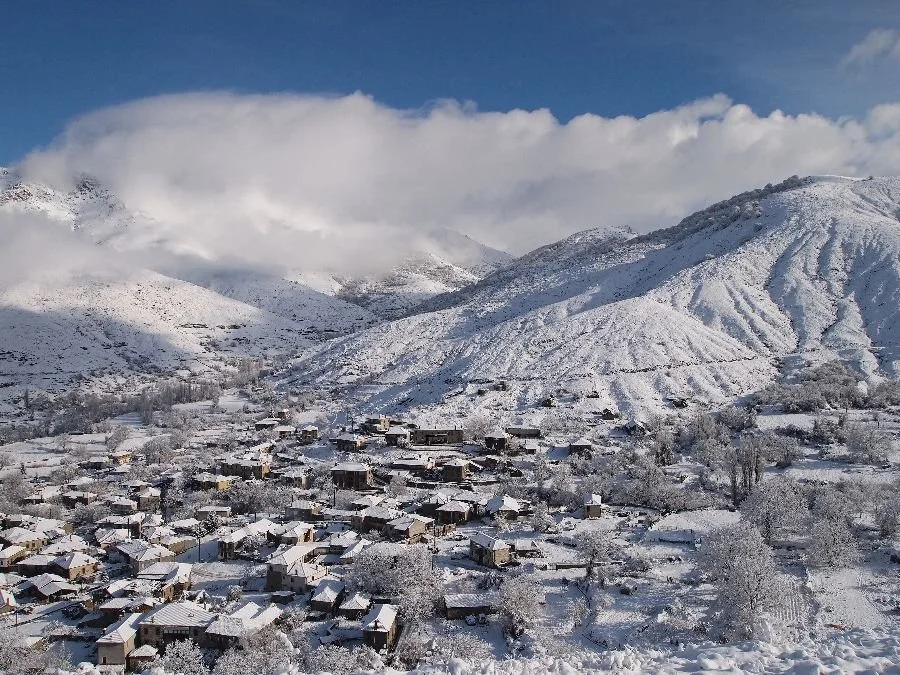
The Village of Agios Germanos
The story told in Lifelines begins in London in 1999, when my wife, Julia, and I found ourselves at a crossroads in our lives. Increasingly tired of not having enough energy or enthusiasm at the end of a working day to enjoy the many things that make London such an extraordinary city, we’d begun thinking about making a radical change by trying to live somewhere else. But none of the places we considered felt right until the day that a book entered our lives. As members of the RSPB at the time, we used to receive a quarterly magazine; and in the back of an issue in 1999, we read a short review of a book called Prespa: A Story for Man and Nature. The book had been written by the Greek biologist and conservationist, Giorgos Catsadorakis, and the review of it was glowing. It spoke of traditional stone villages in the mountains, pelicans on the blue waters, brown bears in the beechwoods and three countries that come together around two ancient lakes: Greece, Albania and North Macedonia. Although we’d never heard of Prespa until then, we were so taken by the review that we thought it sounded like an amazing destination for a week’s holiday. And so we ordered the book. A couple of weeks later, we returned from work to find that it had arrived at our flat in North London. That evening we cooked dinner, opened a bottle of wine and began leafing through this very beautiful but incredibly honest chronicle of a place. We looked at the stunning photographs and read passages aloud to each other. And, at some point that night, we opened a second bottle of wine, which might have played some role in the decision we were about to make, because before going to bed we decided that rather than just going to Prespa for a holiday that we would move there instead. And twenty-six years later, we’re still in the same village that we chose on the basis of a particularly evocative photograph that we’d lingered on that evening. Books can, and do, change lives.
In the summer of 2000, we arrived in Prespa – having journeyed by plane, ferry, bus and taxi to get here – carrying enormous rucksacks that held everything we thought we might need in these new lives of ours. But arriving, of course, was just the beginning of our journey, because the much harder, the more meaningful, and the far richer journey was the journey into the place itself. Which brings me back to the second village that helped raise this book. If it wasn’t for the kindness and generosity we experienced in Agios Germanos when we arrived, with absolutely no idea about what we would do next, I doubt we would still be here today. In fact, if it wasn’t for the help of people throughout the Prespa basin, we might never have stayed. From the day of our arrival, when a guesthouse owner called Vassilis took us under his wing, making it his mission to find us a house to rent after we shared with him our plans, we were welcomed with a hospitality and graciousness that was immediately encouraging. Not only did it make it possible to stay, but it gave us a deeper reason for believing this place could become home.
So much of what we experienced in those early days revolved around practical help and assistance. Like when Vassilis encouraged us to become organic market gardeners, an idea largely premised on the fact that we’d successfully grown cherry tomatoes on our balcony in North London. Not only did he find us fields to rent but he provided an incredible amount of experience, guidance and support. Looking back, I realise how working the land was key to putting down roots here for us. Although we were often comically unorthodox in our agricultural approach in comparison with the practices of local farmers as we set about sowing various herbs, salads and vegetables, we were earning an income in the same way as them, reliant on the waters, soils and weather of this shared landscape. By digging in, both literally and figuratively, we were offered opportunities for contact, connection and conversation. We had work, which was crucial for us to stay; and, just as importantly, it made us part of a community.
As much as anything, this entire journey of ours has taught me that home, at its heart, should be thought of as a verb as much as a noun – something that requires action for it to become real. And that the act of making one can be shared. Which is something we all have the capacity to do, whether it’s reaching out to other people, from different places, or to be better neighbours to the living world we are part of. To see homing as a common and reciprocal endeavour.
But what is this place called Prespa? For a start, it’s not exactly Greece of the imagination. Winters here can be long, hard and cold, when the smaller of the two lakes can freeze hard enough to walk across. In spring and summer, though, thousands of pelicans lift through the heating skies, rising so high above the encircling mountains that you can barely see them with your naked eye. And there are far more brown bears here than bouzoukis.
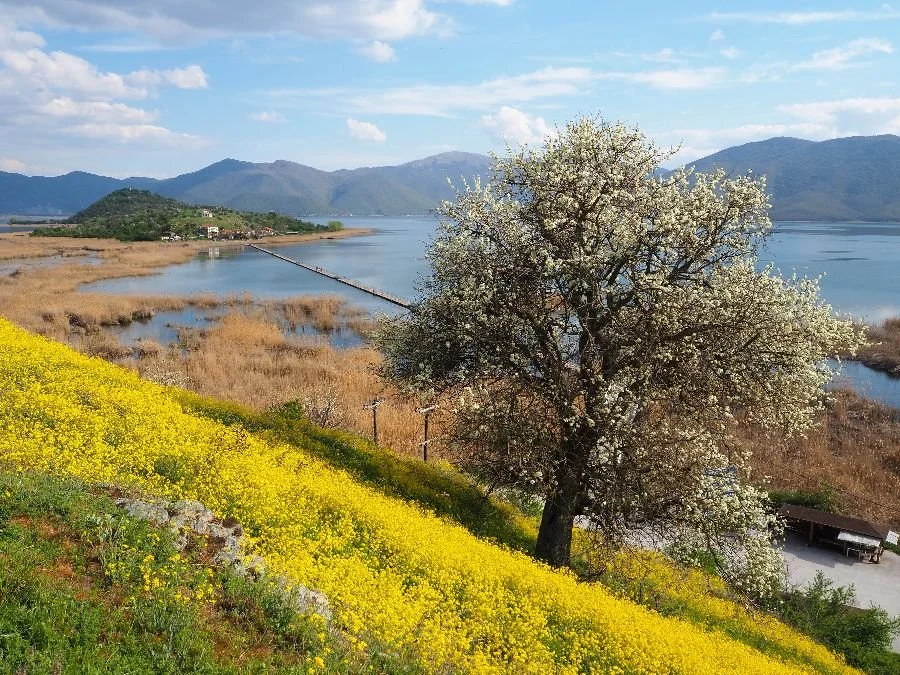
The island of Agios Achilleios, Lesser Prespa Lake
Prespa is a crossroads place. Around that pair of ancient lakes thought to be between three and five million years old meet those three different countries, each of them bringing their own languages, religions, ethnicities, and economic and political histories to the basin. It’s where the heat-dependent ecosystems of the Mediterranean push up into those of the cooler Balkans. And it’s where two entirely different geologies collide: the eastern half of Prespa is composed of dark, brooding granite, while the west is made up of pale and porous limestone. Having both granite and limestone present in the basin means that plant and invertebrate communities that prefer to dwell on one type of geological underlay rather than the other can co-exist in the same watershed. Borders needn’t be thought of solely as sites of separation, but as meeting places, too. Where differences enrich.
It’s this combination of topography, climate and demographics that makes Prespa a place of such extraordinary diversity, both cultural and natural. In the Greek part of Prespa alone are found 172 different butterfly species, which is nearly three times as many butterflies than exist in all of the British Isles. There are at least 1,815 plant species growing here too, which equals 31 percent of Greece’s total number of floral species spread across just 0.3 percent of its land surface. The lakes host the world’s largest colony of endangered Dalmatian pelicans nesting alongside great white pelicans, while as many as sixty to seventy brown bears roam the basin, crossing the borders within that larger homeland of theirs. On an island in Lesser Prespa Lake exist the extraordinary ruins of a thousand-year-old basilica, while the lakeside cliffs on Great Prespa Lake are studded with centuries-old hermitages and monastic cells. Prespa is, above all else, a shared place – a place that became the first Transboundary protected park in all of the Balkans in the year 2000.
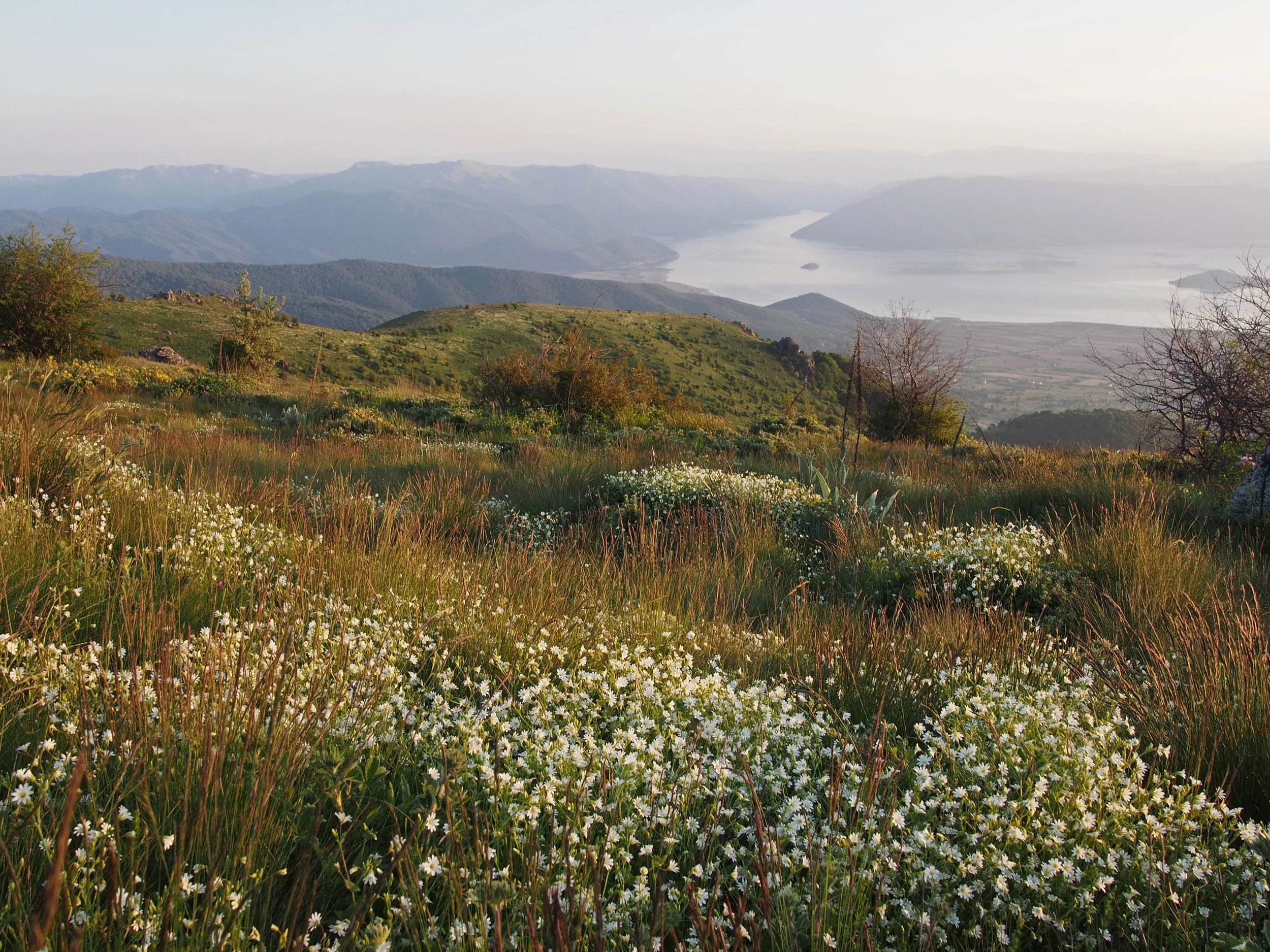
Sub-alpine flower meadows, looking towards Lesser Prespa Lake
Prespa has always been this essential blend of the human and the more-than-human worlds for me. You can’t separate out the different forms of life and still have the same extraordinary place. But like so many parts of rural Greece, it’s a place that faces mounting pressures and challenges. Depopulation is leaving behind emptier and emptier villages. And climate change is impacting the area profoundly, right across the shared watershed, affecting livelihoods, tourism, agriculture and biodiversity. Those ancient lakes that have been around for some three to five million years are now receding dramatically as a result of reduced snow and rain. Great Prespa Lake alone has fallen by a full nine metres since the 1990s, shedding more than half its volume. We are, it seems, at a crossroads in time as well.
Which is why it’s so important for silence to make way for story. For far too long, places like Prespa have been thought of as an edge, where the road runs out and Greece comes to an end. Places that have been marginalised or forgotten. But there’s no such thing as a periphery unless you’re looking at it from somewhere else. From a place or position of power. For those living here – whether the Christian monks of long centuries ago or the farming and fishing communities of today – it’s the very centre of the world. And it’s been an extraordinary privilege to share some of the stories of Prespa in Lifelines, from its rich Byzantine heritage and the lingering scars of the Greek Civil War to the complex changes unfolding here today. Because in the stories of this place are valuable lived realities and memories, paths of empathy and understanding, tools of agency and change. Sometimes the key to reshaping our world begins simply with listening; when an ear can be as transformative as a voice.
Despite a history of frequently difficult relations between the three nations that share the Prespa lakes – traced back to land disputes, religious suspicions, ideological models, territorial names and the movements of people – some of the hard work needed to overcome these schisms is already underway. It’s a place where bridges can, and are, being slowly built, seen in the joint monitoring of bird populations by environmental NGOs, the sensitive, trilateral management of water resources, workshops on joint fire-projection strategies, people’s forums held in each of the three countries, educational, scientific and artistic exchanges, and the collaboration of cross-border municipalities on tourism projects and other mutually beneficial ventures.
It took nearly two decades for the Transboundary Prespa Park to officially become a political and institutional reality, a sign of the immense difficulties in healing international differences and divisions, but also a reminder, particularly at the local level, which is where nearly all of the above-mentioned initiatives originated, of what is always possible through connective cooperation. Through inclusion, solidarity and exchange. A shared endeavour, forged at a crossroads, whose catchphrase sums up its vision: three countries, two lakes, one future. Prespa has not only fundamentally shaped my life, but it has shown me how the lifelines of the world hold together the greater home of us all.
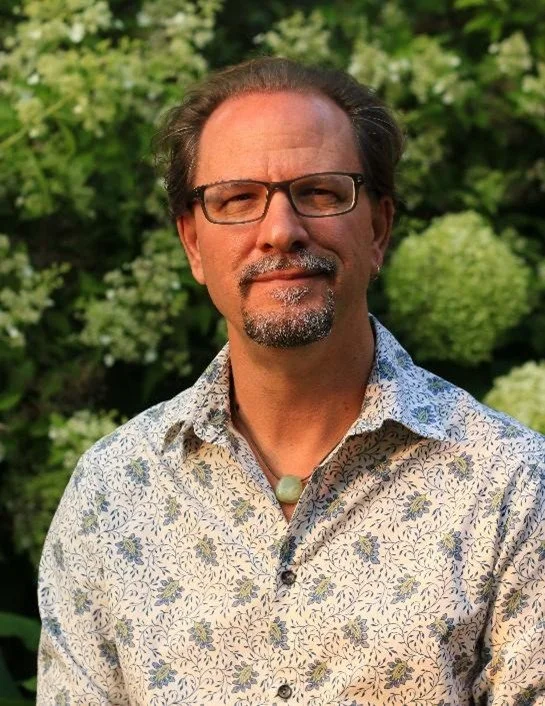
Julian Hoffman, one of our most thoughtful and interesting writers on the natural world, won the 2026 Anglo-Hellenic League Runciman Award for his book, Lifelines. He is the author of two previous books, Irreplaceable: The Fight to Save our Wild Places (Highly Commended Finalist for the Wainwright Prize for Writing on Global Conservation 2020; Royal Geographical Society ‘Book of the Year’ 2020; shortlisted for ASLE UK Book Prize for Literature and Environment 2021) and The Small Heart of Things (Winner of both the 2012 AWP Award for Creative Nonfiction and the National Outdoor Book Award for Natural History Literature, as well as being a finalist for the Foreword Book of the Year in Ecology and Environment and the ASLE Book Award for Literature and Environment). Although he was born in the UK and grew up in Canada, Julian has lived for the past quarter of a century beside the Prespa lakes in the mountains of northern Greece.